
The Best Fence Materials for Salt Air on the Cape Fear Coast
Salt air is the single biggest reason fences fail in Wilmington. Choose the wrong material and the ocean will have your fence rusting, warping, or leaning within a few years. Choose the right one and it'll look good for decades. Here's how the common options really stack up on the Cape Fear coast.
First, understand the enemy
Salt-spray concentration is heaviest within the first few thousand feet of the water, but corrosion effects have been measured five to ten miles inland. And humidity above 60% — the baseline across our region — roughly doubles corrosion rates on metal compared to a dry climate. So even a few miles from the beach, your fence is under salt stress. That reality should drive every material and hardware decision.
Aluminum — the coastal champion
Aluminum is the best-performing metal near salt water, full stop. It forms a self-healing oxide layer that blocks corrosion, and in salt-spray testing it retains roughly 98% of its strength after ten years — versus about 71% for galvanized steel. Add a powder-coat finish and it stays crisp and black for decades. The trade-off is that it's an open, ornamental style, so it doesn't provide privacy. For waterfront lots, pool enclosures, and HOA communities, it's usually the right answer. See our aluminum fencing page for styles and grades.
Vinyl (PVC) — low-maintenance privacy
Vinyl doesn't rot or corrode, needs no staining, and shrugs off the mildew our humidity encourages — which makes it excellent for coastal privacy. The catch is quality: thin, low-UV vinyl can grow brittle and discolor after about a decade of intense coastal sun. Coastal-grade vinyl with high UV-resistance, thicker walls, aluminum-reinforced rails, and stainless hardware avoids that. It's the go-to when you want privacy without upkeep. More on our vinyl fencing page.
Wood — warm and affordable, but needs care
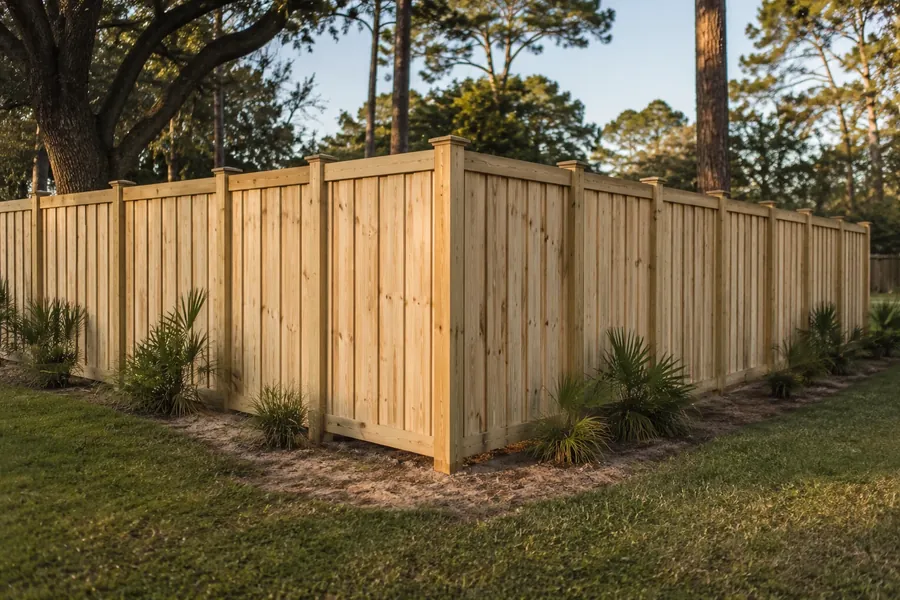
Wood is still the most popular privacy choice for its natural look and lower up-front cost, and it can absolutely last on the coast — if it's built right and maintained. That means coastal-treated lumber, galvanized or stainless fasteners (never bright steel), deeper footings, and an annual seal against salt and UV. Skip the maintenance and salt-laden humidity will rot the base of the pickets. Our wood privacy fencing page covers coastal construction, and the maintenance guide covers upkeep.
Chain-link — function over form
Plain galvanized chain-link can rust near the ocean, especially at the fittings. Vinyl-coated (black) chain-link adds a polymer corrosion barrier and looks far better, receding into a treeline. For dog runs, back property lines, and commercial yards on a budget, it's a practical coastal choice. See chain-link fencing.
The bottom line
The closer you are to the water, the more the answer tilts toward aluminum and stainless hardware. For privacy, coastal-grade vinyl leads on low maintenance, while well-built and maintained wood wins on budget and warmth. Whatever the material, the hardware and footings matter as much as the fence itself in this climate. Not sure what fits your exposure? Ask us for a free assessment — we'll give you a straight recommendation for your specific lot, whether you're in Wrightsville Beach or a few miles inland in Leland.
